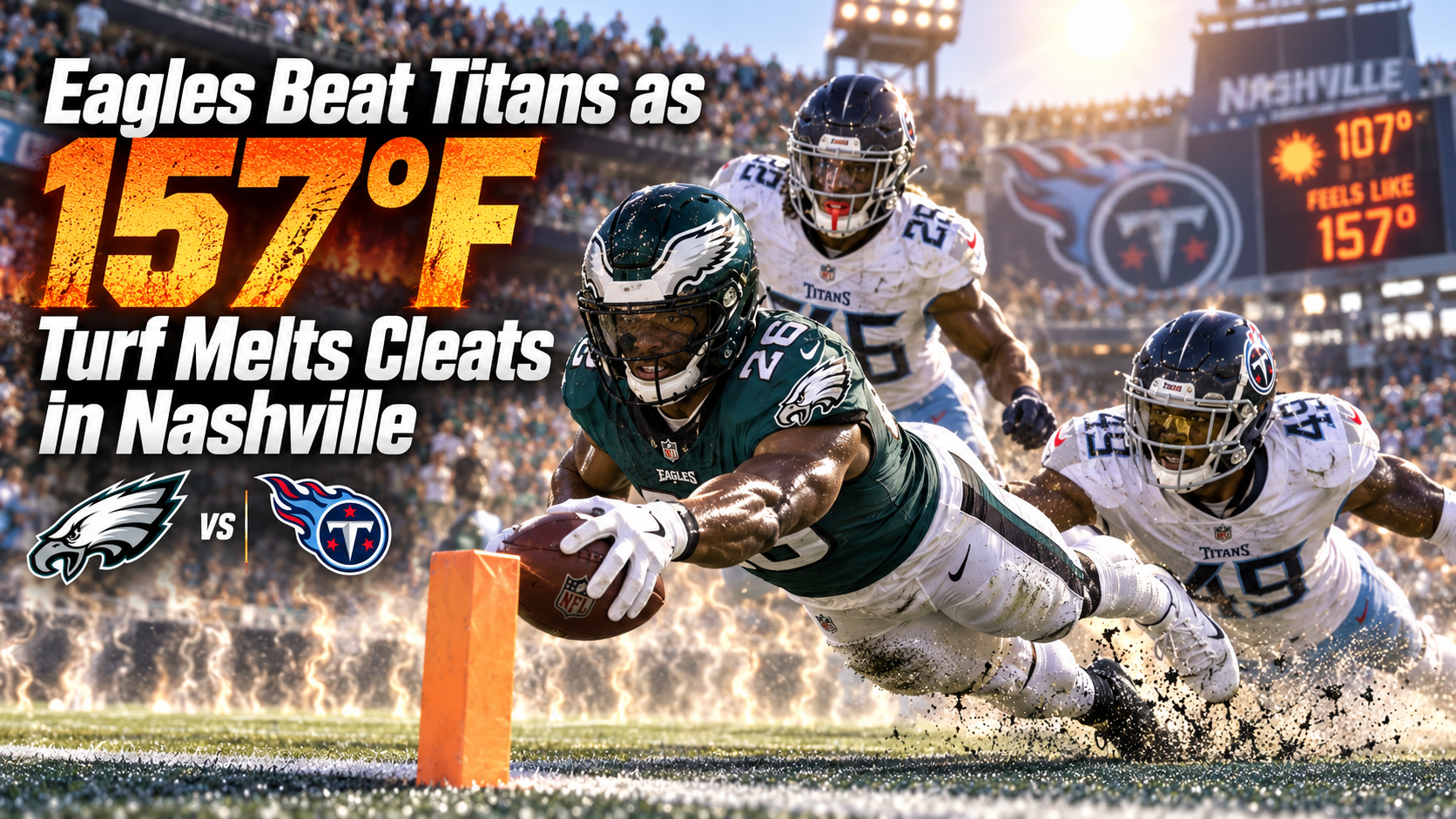
The Philadelphia Eagles escaped Nashville with a 24-20 victory over the Tennessee Titans, but the final score was only part of the story.
With the air temperature reaching 95°F and the heat index climbing to around 105°F, players were already dealing with punishing conditions at Nissan Stadium. Then came an even more startling number: according to the Fox broadcast, the artificial turf reached 157°F (69.4°C) during the third quarter.
Where to Watch NFL Games
Paramount+

Paramount+
Big games, top soccer, and major events at a price that’s easy to love
DAZN

DAZN
Every punch, every round, every fight night in one place
FUBO

FUBO
The live sports streaming service built for fans who want it all
The surface became so hot that players changed damaged cleats, team personnel poured water over footwear during breaks, and Eagles head coach Nick Sirianni required an IV despite never stepping onto the field for a snap.
Philadelphia still found a way to win. But the extreme conditions left players asking whether an NFL game should ever be played on a surface that hot.
The 157°F Number That Changed the Story of Eagles-Titans
Nashville was under a heat warning when the game kicked off at noon local time on September 20. The air temperature was approximately 95°F, with a heat index of 105°F.
The artificial field was considerably hotter.
Fox reported a surface temperature of 157°F during the third quarter, turning an already difficult afternoon into an unusual equipment and player-safety challenge.
Artificial surfaces can become substantially hotter than natural grass when exposed to direct sunlight. A systematic review of research comparing synthetic and natural sports surfaces found consistently higher surface temperatures on synthetic grass, with differences ranging from 9.4°C to 33.7°C depending on the conditions and materials involved.
That difference was impossible for the players to ignore in Nashville.
Eagles coach Nick Sirianni said afterward that even without playing, the conditions were severe enough that he needed an IV. He praised his players for continuing to compete through an afternoon that tested both teams physically.
Cam Jurgens Went Through Multiple Pairs of Cleats
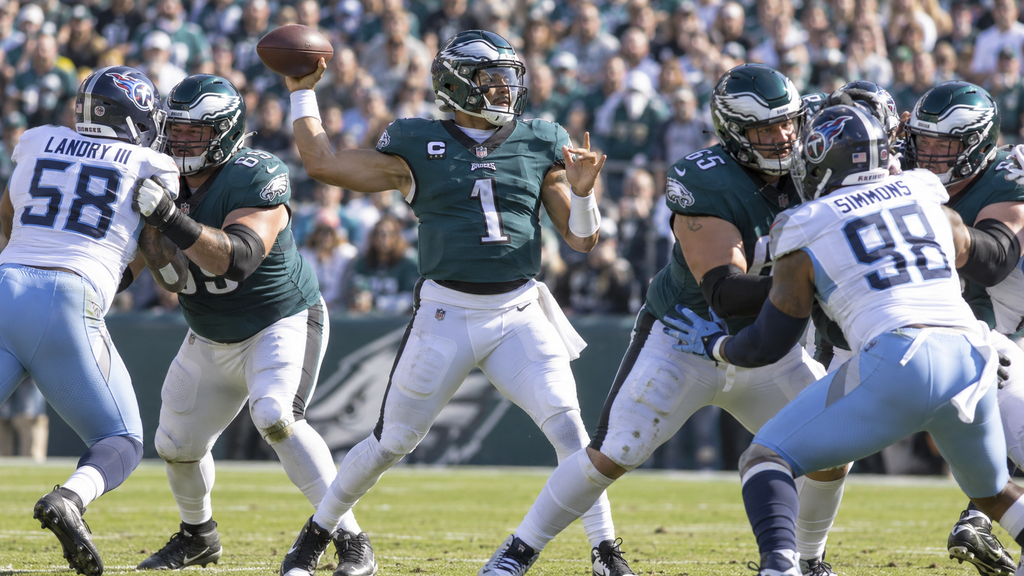
For Eagles center Cam Jurgens, the heat created a problem that went beyond hydration.
His footwear began deteriorating.
Jurgens told reporters that he went through multiple pairs of cleats as heat radiated upward from the synthetic field. By halftime, Philadelphia’s equipment staff was working quickly to get him into another pair so he could continue playing.
He compared the process to a NASCAR pit crew and said his feet were still burning after the game.
Television cameras also captured personnel pouring water over players’ cleats during breaks in an effort to cool them.
The Eagles weren’t the first team to encounter the problem.
During Tennessee’s season opener against the New York Jets one week earlier, Titans safety Amani Hooker said the midsole of one of his shoes had melted completely off. The fact that footwear problems surfaced in consecutive games at Nissan Stadium made Sunday’s scenes particularly concerning.
For Jordan Mailata, that previous incident suddenly made much more sense.
The Eagles left tackle acknowledged that he had initially been skeptical when he heard about the Titans’ problems a week earlier. After experiencing the surface himself, he understood how extreme it could become.
Jordan Mailata Says the NFL’s Turf Debate Just Got Bigger
The NFL’s argument over artificial turf is not new.
Players and the NFL Players Association have previously pushed for greater use of natural grass, with much of the debate focusing on traction and lower-body injuries. The NFLPA has argued that natural grass should become the league-wide standard while calling for stronger testing and safety requirements for synthetic surfaces.
What happened in Nashville added another issue to that discussion: heat.
Mailata said he had never seriously considered how much hotter a turf stadium could feel until experiencing Nissan Stadium firsthand.
“This is why we want all grass fields,” he said while discussing the conditions and the union’s push for safer playing surfaces.
His concern wasn’t purely theoretical. Mailata reportedly rolled his ankle twice during the game and questioned whether the extreme temperature had softened parts of his cleats enough to affect their stability.
That doesn’t establish that the turf caused the ankle issues, but it demonstrates why players are concerned about what happens when footwear engineered for football is exposed to extraordinary surface temperatures.
Why Was the Game Played at Noon During a Heat Warning?
The playing surface wasn’t the only issue questioned after the game.
Sunday’s matchup began at noon local time while Nashville was under a heat warning, placing the game near the most intense period of daytime solar exposure.
According to reports after the game, some players and staff questioned why an early-afternoon kickoff had been scheduled in Nashville during September given the potential for hot and humid conditions.
NFL scheduling is complicated. National and regional television windows, travel, stadium availability and dozens of other factors determine when games are played.
Where to Watch NFL Games
Paramount+
Paramount+
Big games, top soccer, and major events at a price that’s easy to love
DAZN
DAZN
Every punch, every round, every fight night in one place
FUBO
FUBO
The live sports streaming service built for fans who want it all
But the Eagles-Titans game illustrates the difficult question the league may increasingly have to address: At what point should extreme field conditions trigger additional precautions or scheduling changes?
There is an important distinction between air temperature and playing-surface temperature. A forecast may indicate conditions that are manageable with hydration, shade and cooling measures while the field itself becomes dramatically hotter under direct sunlight.
In Nashville, that difference was approximately 62 degrees.
Artificial Turf Has Been Part of the NFL for Decades — But the Debate Has Changed

Artificial turf is hardly new to professional football.
Franklin Field in Philadelphia became the first NFL stadium to use artificial turf when AstroTurf was installed in 1969 while the Eagles still played their home games there.
Synthetic fields subsequently became common because they can withstand intensive use, require different maintenance than natural grass and provide teams with a consistent playing surface in stadiums used for multiple events.
But modern research has also demonstrated one of their clearest drawbacks during hot weather: synthetic fields can reach much higher surface temperatures than natural grass.
One reason is the absence of the evaporative cooling that occurs with living grass and soil. Research has also identified differences in solar absorption and the thermal properties of synthetic materials that allow artificial surfaces to heat rapidly in direct sunshine.
At Nissan Stadium, that characteristic became impossible to overlook.
The Titans’ New Stadium Should Eliminate This Particular Problem
The current Nissan Stadium is approaching the end of its life as the Titans’ home.
A new Nissan Stadium is already under construction nearby and is scheduled to open in 2027. Unlike the current outdoor venue, the replacement will be a domed stadium with a translucent roof and dedicated heating and cooling systems.
That means Sunday’s exact combination of direct sunlight, extreme outdoor heat and a scorching exposed playing surface should not follow the Titans into their new home.
The broader NFL issue, however, will remain.
Other teams continue to play on synthetic surfaces, including in venues where high temperatures can become a factor. The NFL and NFLPA will therefore continue to face questions about how fields are tested, what temperature thresholds should trigger intervention and whether natural grass should eventually become a universal standard.
A 24-20 Win That Became Bigger Than the Final Score
For Philadelphia, the afternoon ultimately ended with another victory.
But the enduring images from Nashville were not simply touchdowns or defensive stops. They were players cooling their shoes with water, equipment staff replacing cleats and a head coach receiving IV fluids after spending three hours on the sideline.
A reported 157°F field temperature transformed an ordinary September NFL game into a case study in how extreme heat and playing-surface technology can intersect.
The Eagles managed to leave Nashville with a 24-20 win.
The larger question now belongs to the NFL: whether melted footwear and emergency cooling measures should be treated as an extraordinary one-off event — or as a warning that the league’s standards for playing in extreme heat need another look.
Where to Watch NFL Games
Paramount+
Paramount+
Big games, top soccer, and major events at a price that’s easy to love
DAZN
DAZN
Every punch, every round, every fight night in one place
FUBO
FUBO
The live sports streaming service built for fans who want it all